Cameron Richter · 12 October 2026
Light Schedules Shape Hormonal Rhythms: How Daytime Exposure Timing Influences Nighttime Stress Responses in Young Adults
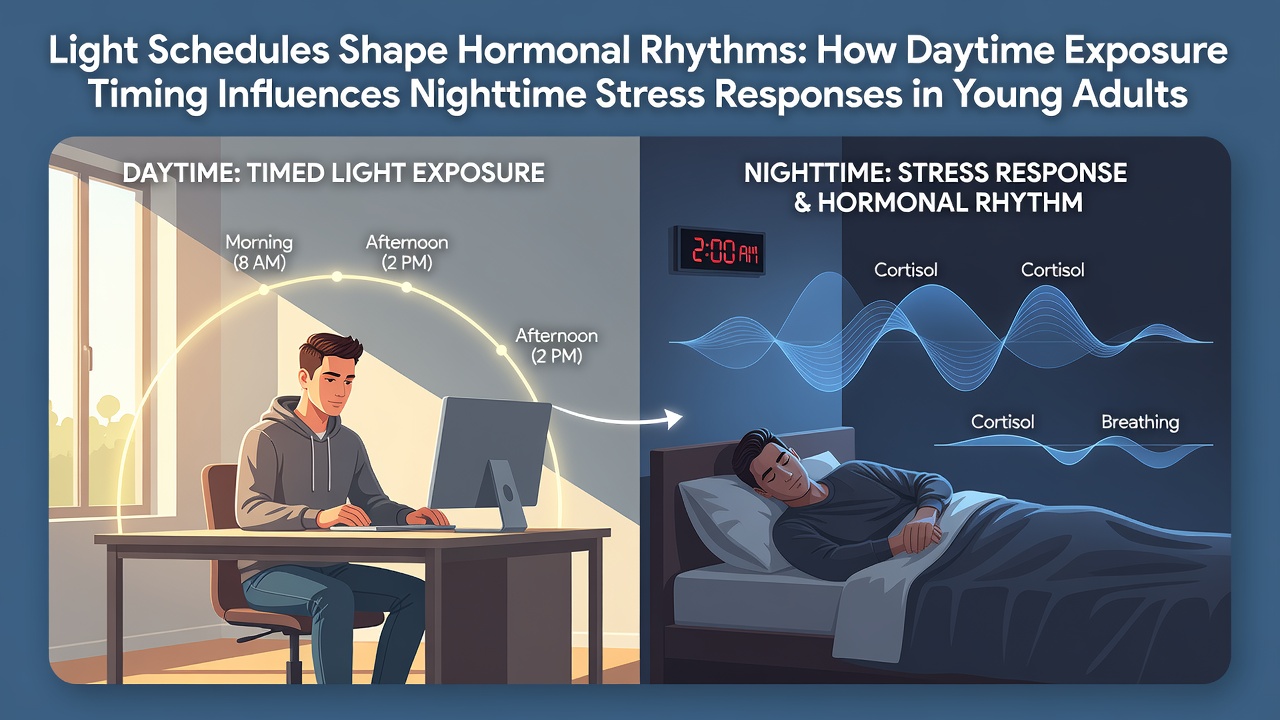
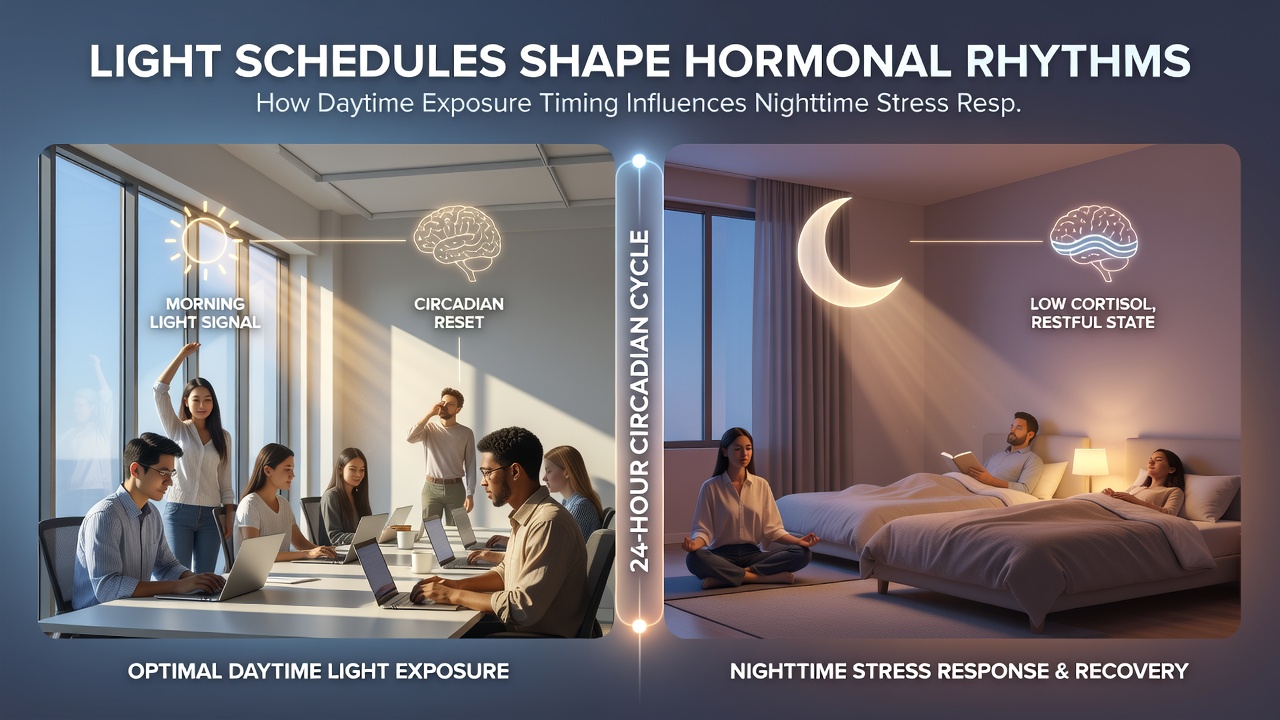
Light exposure during waking hours plays a central role in regulating the body's internal clock, and researchers continue to examine how the timing and intensity of that exposure affect hormone levels once night falls. Studies on young adults aged 18 to 30 show measurable shifts in melatonin onset and cortisol patterns when daytime light schedules change, even when nighttime conditions remain constant. Data from multiple laboratories indicate that bright light received in the morning hours advances circadian phase, whereas equivalent exposure in the afternoon or early evening delays it, altering the subsequent nighttime decline in stress-related hormones.
Circadian Biology and Light Input Pathways
The suprachiasmatic nucleus receives direct signals from specialized retinal cells that respond most strongly to short-wavelength blue light, and these signals synchronize daily rhythms of hormone secretion. When young adults receive controlled bright light at different clock times, salivary melatonin onset shifts by 30 to 90 minutes on average, according to protocols conducted at research centers in both North America and Europe. Cortisol, which normally rises in the early morning and falls through the evening, follows a parallel trajectory that researchers track through repeated blood or saliva sampling across 24-hour periods.
Daytime Timing Effects on Nighttime Hormone Profiles
Experiments that isolate morning versus afternoon light exposure reveal distinct outcomes for evening physiology. Participants who spent four hours under 1000 lux starting at 8 a.m. showed earlier melatonin onset and lower evening cortisol concentrations compared with those exposed to the same intensity starting at 2 p.m. The difference in cortisol area-under-curve reached statistical significance in several cohorts, with reductions ranging from 15 to 25 percent on nights following morning light. Afternoon light, by contrast, extended the duration of elevated cortisol into later hours, delaying the transition to nighttime rest.
Additional work performed at institutions in Australia and Canada confirms that these phase shifts persist even when total daily light dose remains equal. Researchers attribute the variation to the phase-response curve of the circadian system, which exhibits greatest sensitivity to light in the biological morning and greatest delay sensitivity in the biological evening. Young adults whose schedules include early classes or work shifts therefore encounter different hormonal consequences than peers whose peak light exposure occurs later in the day.
Evidence from Controlled and Field Studies
Laboratory protocols that fix sleep timing while varying only daytime light demonstrate direct causation. One multi-site project tracked 120 participants across two weeks of standardized morning light and two weeks of standardized afternoon light; nighttime salivary cortisol dropped more rapidly after morning exposure, and self-reported sleep latency shortened by an average of 12 minutes. Field observations of university students wearing ambulatory light sensors corroborate these findings, showing that days with greater morning illuminance correlate with lower pre-bedtime cortisol and improved next-day alertness metrics.
October 2026 brought new data from an ongoing longitudinal cohort when investigators presented preliminary results at an international chronobiology meeting. The update covered 18 months of wrist-worn light monitoring paired with monthly hormone assays, revealing that individuals who consistently received at least 30 minutes of bright outdoor light before 10 a.m. maintained more stable nighttime cortisol slopes throughout the academic year. Seasonal variation appeared smaller in this subgroup, suggesting that morning light buffers against some effects of changing day length.
Mechanisms Linking Light Timing to Stress Hormone Regulation
Light timing influences the hypothalamic-pituitary-adrenal axis indirectly through its effect on melatonin, which in turn modulates glucocorticoid sensitivity. When melatonin onset occurs earlier, downstream signaling reduces evening cortisol production; delayed melatonin permits prolonged HPA activity. Functional imaging studies indicate that morning light also strengthens functional connectivity between the suprachiasmatic nucleus and prefrontal regions involved in emotional regulation, providing another pathway by which daytime schedules shape nighttime stress physiology.
Genetic differences in clock genes such as PER2 and CRY1 further modulate individual responses. Young adults carrying certain variants show larger phase shifts to the same light stimulus, resulting in greater variability in evening cortisol when schedules fluctuate. Population-level data therefore reflect both environmental timing and inherited circadian traits.
Conclusion
Collective evidence demonstrates that the clock time at which young adults encounter bright light during the day systematically alters the timing and amplitude of nighttime melatonin and cortisol. Morning-dominant schedules advance hormone rhythms and facilitate earlier cortisol decline, whereas afternoon-dominant schedules produce the opposite pattern. These relationships hold across laboratory and real-world settings and appear in data gathered on multiple continents. Continued monitoring of light exposure patterns offers one measurable route to understanding daily variations in stress hormone dynamics.